
Media Gallery
More about the dhimanp Periodic Table
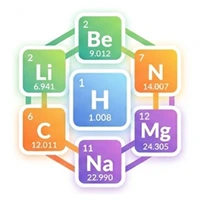
This is a very simple periodic table app where all the elements exist in a proper periodic table with groups and periods. In this app, the periodic table is based on the Bohr model. This app easily explains all the elements according to the groups and electronic configurations.
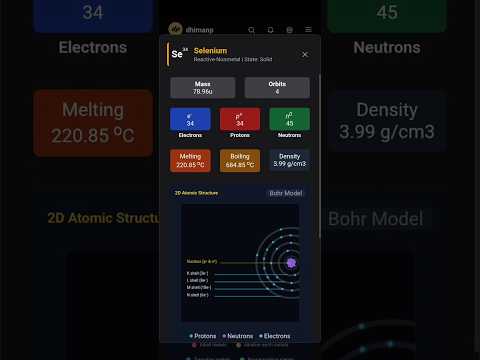
This app contains a pop-up-based UI for exploring each and every element in detail, including the total number of electrons, protons, neutrons, and electron configurations with proper s,p,f, etc. shell configurations. This app also explains real-life fun facts about each element. The main feature of this app is that you can see the live 2D atom structure with proper shell-configured electrons of each element.
How It Works?
Our periodic table is designed for everyone who wants to learn the chemical elements with real-life examples.
- Science Students: Any science student can learn about every element without any rote learning.
- Science Teacher: Any teacher who wants to teach the periodic table interestingly.
- Scientists: This app is a quick reference of all the atoms, so you can use this app for quick references without installing any application.
Key Features of the Periodic Table
- Provide all elements with proper grouping and periods.
- Provide a live 2D Bohr atomic structure with rotating electrons, shell configurations, and electron distributions.
- Provide real-life use cases of each element.
- Provide fun facts about the elements.
- Provide the melting and boiling points in Celsius and the density of each element.
- Additionally, this app provides the discoverer and discovery year of the elements.
- This app is totally free with zero hidden charges.
- Easy and simple user interface.
What’s New
- Initial release of the Periodic Table web app
- Added interactive element grid with detailed popups
- Included real-life applications and fun facts for elements
- Responsive design optimized for desktop, tablet, and mobile views
- Fast search and categorization filter implementation
Why Choose Periodic Table?
We've seen many periodic tables, but they show only a 2D or 3D atomic structure and don't explain the proper electron configuration. This app explains the proper electron configuration based on each element's shells.
Also, our team observed that in many places, the instructor directly suggests rote learning of these elements,but with the help of real-life use cases and fun facts about each element, anyone can easily understand the elements and their properties.
This is not just a periodic table; this is the bridge between chemistry, atoms, and the real world.
User Feedback 4 Total
❝Excellent❞
❝this is very good❞
❝bdiya s❞
❝good❞
Rate this App
Reviews are published after a quick safety check (usually within 24 hours).
Reviews are public. Developers can see basic device specifications to respond. Learn more
Rutherford Model
Rutherford model was proposed by Ernest Rutherford. According to this model, the atom has more space, with a small center with a dense, positively charged nucleus. The electrons are rotating around this nucleus.
But this model was unable to explain atomic stability because, according to classical physics, the electrons lose energy during rotation; as a result, the electrons fall down to the nucleus. That is why this model failed to explain electron stability, and hence the Bohr model easily explained this stability.
Bohr Model
Niels Bohr proposed the Bohr model in 1913. This model emerged because Rutherford’s atomic model couldn’t explain atomic stability. According to the Bohr model, electrons orbit the nucleus in circular motion at fixed energy levels or shells. When the electron passes from one shell to another shell, the electron releases or absorbs energy. We are using this Bohr model because it explains the atomic spectra and stability in a better way.
How did the Periodic Table start?
Periodic Table was developed by Dmitri Mendeleev in 1869 by organizing the elements by their weights and other properties. Dmitri Mendeleev proposed this model in front of the Russian Chemical Society in March 1869.
Further, Henry Moseley suggested the atomic number concept in this table. After the Bohr model, everyone easily understood that the table is divided into groups and periods because the chemical properties of the elements depend on the valence electrons, and the Bohr model explains that electrons are arranged into different shells.
Importance of Atoms in the Human Body
You can explore this Cosmic Eye video to better understand the importance of the elements in atoms in RNA and DNA in the human body.

Do you know?
In any element, the number of electrons is equal to the number of protons for a stable atom. But with the help of some reactions, atoms can release electrons and also release energy, and if an atom accepts a new electron from another atom, then it needs more energy. These types of atoms are called unstable atoms.
Why can't electrons exist in the nucleus?
On the basis of Heisenberg’s uncertainty principle, the radius of the atomic nucleus is of the order of 10-15 m, and if the electron were to exist in the nucleus, then the maximum uncertainty in its position would be 10-15m.
Hence, the value of uncertainty in velocity is much higher than the velocity of light (3.0x10⁸ms-1), and therefore it is not possible. Hence, an electron cannot be found within the atomic nucleus.
Privacy Policy
Periodic Table app does not collect personal data from users. However, if users choose to send feedback or contact the developer, the information provided (such as message content) will be used solely to respond to feedback or improve the app. We do not sell or share user information with third parties.
Frequently Asked Questions
1. Why is the Periodic Table important for us?
Periodic Table organizes the elements so that anyone can easily understand the elements and their reactions. This plays an important role in materials science and chemistry.
2. What is the meaning of the Periodic Table?
It is a chart that contains the elements, and these elements are arranged in groups and periods according to their properties, like gas, solid, liquid, how many electrons, protons, etc.
3. What is a Nucleus?
The nucleus is the central part of an atom that contains the neutrons and protons.
- Protons are positively charged, and the symbol is p+.
- Neutrons don’t have any charge, so they are neutral, and the symbol is n.
- Electrons are present outside the nucleus, are negatively charged, and the symbol is e.
4. Difference between Atom and Element
Atom: An atom is the smallest individual unit of a chemical substance that retains its chemical properties. It consists of a nucleus protons and neutrons) surrounded by electrons.
Element: An element is a collection of similar atoms that have the same atomic number) Hence, an element is a pure chemical substance made up entirely of atoms that share the same atomic number. For example, pure gold is an element composed exclusively of gold atoms.