
Be a Master at GST: Rate Slabs, Counter Calculations, and Top Billing Blunders to Dodge
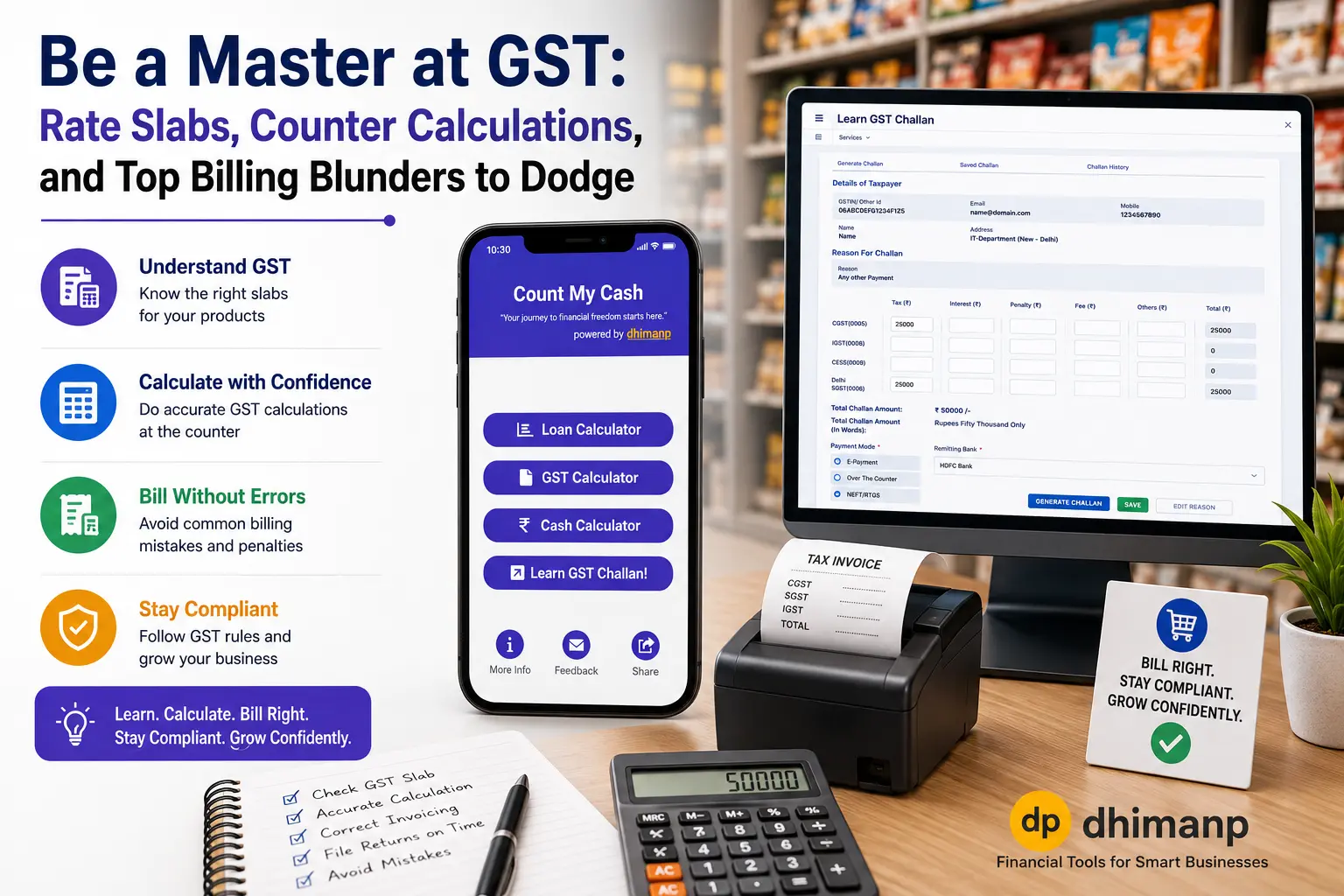
If you own a small retail shop or business, GST can be an arduous task for you. Deciding which GST slab should apply to your goods and then calculating the amount of tax quickly during rush-hour billing at the counter requires accuracy to ensure that you do not end up paying fines.
Here is an all-encompassing guide on three key areas of everyday business – GST slabs, counter GST calculations, and common billing mistakes.
Understanding GST Rates (5%, 18%, 40%, 0%)
GST system in India classifies goods/services based on different tax slabs. It is important to understand the GST slab applicable for your product range in order to properly price the products and make a proper invoice.
Four Main GST Slabs
- 0% (Nil Rate): Fresh unbranded foods, milk, fresh vegetables, life-saving medicines, and educational services.
- 5% (Merit Rate): Packaged food items, edible oils, basic clothing, and general household necessities like tea, coffee, and basic life goods.
- 18% (Standard Rate): Most consumer electronics, refrigerators, mobile phones, standard restaurant dining, and regular services.
- 40% (Luxury & Sin Goods): High-end luxury cars, premium motorcycles, tobacco, pan masala, and aerated sugary beverages.
Niche & Special Rates
- 3%: Gold, silver, and other precious jewelry/gemstones.
- 0.25%: Rough diamonds and uncut precious stones.
Watch the YouTube video to know the GST Slab categories.
Video: India's GST Slabs 2026 (BIG CHANGES) by WallStreetMojo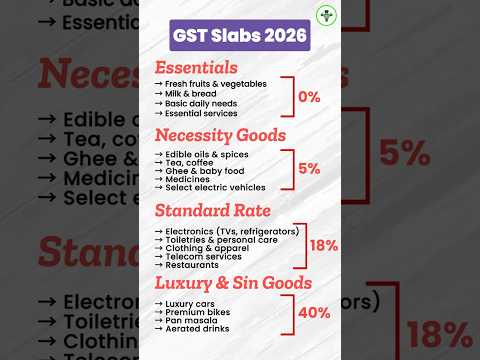
Method of Calculating Inclusive/Exclusive GST for Counter Invoices
The process of charging the client at the point of sale should be swift and precise. Based on the pricing policy you employ, item prices can be stated either Exclusive of Tax (tax charged at point of sale) or Inclusive of Tax (tax included in retail price tag).
1. Exclusive GST Calculation (Adding Tax to Base Price)
In an exclusive calculation, you add the tax percentage on top of the base product price.
Formula:


For Example:
Suppose a customer buys an item with a base price of ₹1,000 at an 18% GST rate.


2. GST Inclusive Calculation (Extracting the Tax from Retail Price)
In MRP billing, GST is included in the price tag itself. It becomes necessary to calculate backwards to find out the actual base price and GST amount.
Formula:


For Example:
Suppose an item sells for an inclusive MRP of ₹1,180 at an 18% GST rate.


3. Splitting CGST and SGST for Local Sales
For intra-state sales (sales within the same state), the total GST amount is divided equally between Central GST (CGST) and State GST (SGST):

For the ₹180 GST calculated above, the split is ₹90 CGST and ₹90 SGST.
- GST Calculator is used to calculate the GST amount with inclusive or exclusive, with combined GST or split SGST and CGST (IGST).
- Loan EMI Calculator is used to calculate the total number of EMIs and how much per EMI.
- Cash Calculator is used to get the total amount of 500, 200, etc. Indian rupees.
It is very helpful if you are a cashier or your job is to calculate the total cash every day. And I have personally used this cash calculator in an Indian wedding to calculate the cash.
In Indian weddings, everyone normally gives cash directly or in a cash cover draft called Shagun. And to find out the total amount of the cash is very difficult. But with our application, Count My Cash, it is super easy.
Common Errors Committed by Small Business Owners while Billing GST and Ways to Correct Them
Even small mistakes made in counter billing can lead to compliance notices or discrepancies while reconciling Input Tax Credits (ITC). Below is a list of common mistakes made by small businesses and ways to rectify them:
1. Incorrect Application of the Tax Slab
Problem: Charging 18% on a good when the applicable slab is 5%, or not updating slabs in case of any change through a tax notification.
Solution: Keep your inventory database updated digitally with correct HSN/SAC codes and their active GST slab rates.
2. Calculation Mistakes Between Inclusive & Exclusive Prices
Problem: Directly charging 18% on the MRP of a product (for example, 1180 x 0.18 = 212.4), making the customer pay more than required in taxes.
Solution: Use reverse calculation method ("MRP"/1.18) for all such cases.
3. Wrong Allocation of CGST/SGST or IGST
The Mistake: Applying CGST/SGST on intra-state transactions where Integrated GST (IGST) should be charged, or applying IGST on local counter transactions.
The Solution: Verify the place of supply before preparing the invoices. In case of a local over-the-counter transaction, CGST & SGST are charged; otherwise, in case of a shipment transaction, IGST is charged.
4. Omission of Mandatory HSN Codes or Tax Details
The Mistake: Giving receipts without HSN codes and tax details, or giving receipts without clear mention of CGST/SGST breakdown.
The Solution: Set up the POS billing software or calculator for automatic printing of line-item HSN codes and percentage of CGST/SGST.
5. Late Filings and Discrepancies in GSTR-1 vs. GSTR-3B
The Mistake: Entering a different value of taxable sales in the monthly filing return compared with register entries.
The Solution: Cross-verification of sales register with monthly account summary.
Summary Checklist for Non-Compliance with Compliance
- Verify Slabs: Make sure that all items in your shop have the right GST slab (0%, 0.25%, 3%, 5%, 18%, and 40%) attached to them.
- Understand the Formulae: Either use automated calculators or POS systems for doing calculations without any error.
- Indicate Tax Information: Make sure that the invoice has all the information of the base amount, tax percentage, CGST, SGST, and the total amount.
- Audit Bill Issuing Weekly: Conduct weekly audits of your bill issuance process.
Conclusion
So, by knowing the current financial year GST Slab rates and knowing the correct formulae to calculate the GST, IGST, CGST, and SGST, you could be the master at GST. And if you learn how to create the GST Challan, then you can conquer the whole GST process. And if you want to interesting for GST Challans, then you can read our article How to Create and Verify GST Challans: A Step-by-Step Practice Guide .In this article, we have explained the whole process in detail.
Frequently Asked Questions (FAQ)
GST Slabs & Counter Billing Calculations
1. What are the main GST rate slabs in India?
The main GST slabs are 0% (Nil Rate for essential unbranded food, milk, fresh produce), 5% (Merit Rate for packaged food staples, edible oils, basic clothing), 18% (Standard Rate for electronics, restaurants, consumer goods), and 40% (Luxury & Sin Goods like high-end cars, tobacco, aerated drinks). Special rates of 0.25% and 3% apply to rough diamonds and precious metals respectively.
2. How do I calculate GST on MRP (Inclusive GST)?
To extract GST from an MRP price, divide the total MRP by (1 + (GST Rate / 100)) to get the base price. Subtract the base price from the MRP to find the GST amount. For example, for an MRP of ₹1,180 at 18% GST: Base Price = 1180 / 1.18 = ₹1,000, and GST Amount = ₹180.
3. How does the Count My Cash app help retail store cashiers?
Count My Cash is an Android utility featuring three tools: a GST Calculator (calculates inclusive/exclusive GST with CGST/SGST/IGST splits), a Cash Calculator (tallies Indian Rupee notes like ₹500, ₹200 with totals in text for easy drawer/shagun reconciliation), and a Loan EMI Calculator.
4. What is the difference between CGST/SGST and IGST?
For local intra-state sales within the same state, GST is split equally into CGST (Central Tax) and SGST (State Tax). For inter-state sales across state borders, the full GST amount is charged as IGST (Integrated Tax).