
Level Up Your Brain: Why Educational Games are the Future of Mental Math in 2026
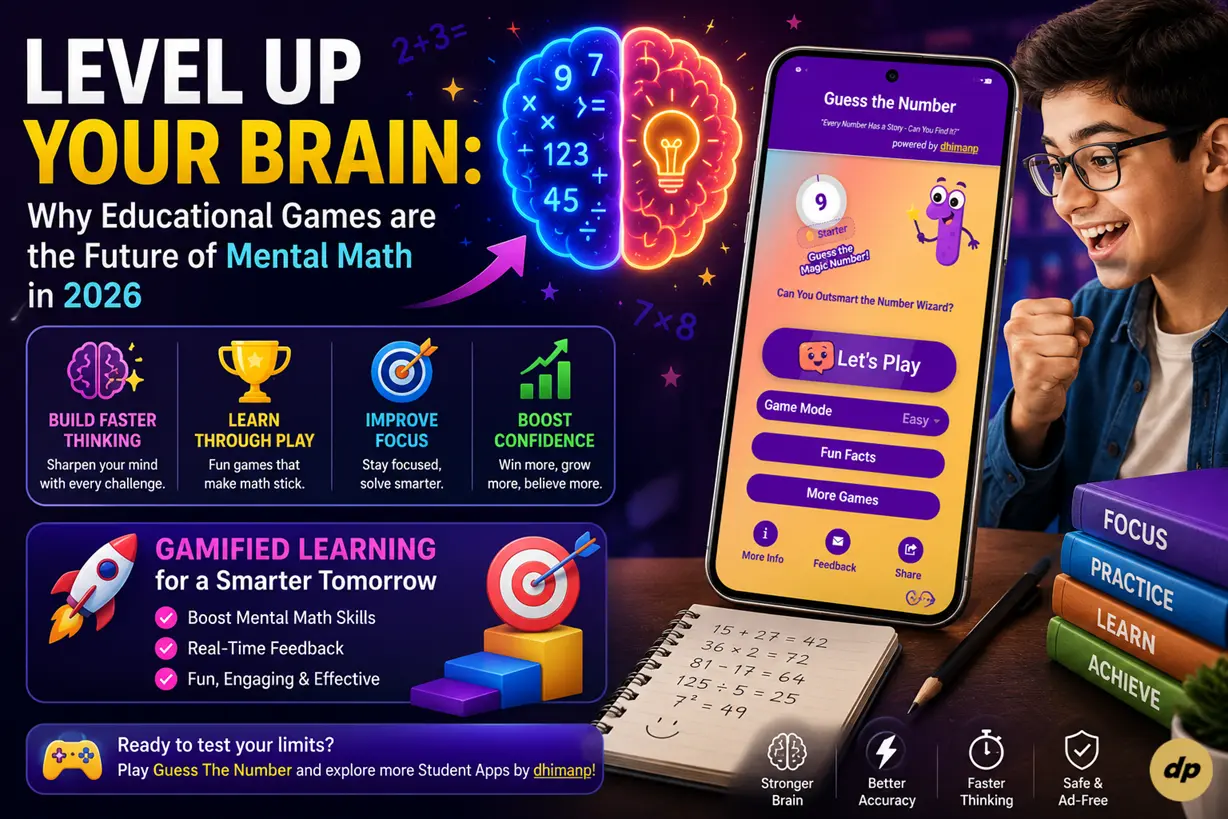
As we know, in the year 2026, everyone is talking about artificial intelligence, and as a parent or a teacher, we commonly ask: Is there any point in teaching a kid mental math?
And the answer is a simple yes. In this AI era, this is possible. Mental math is not just remembering the counting from 1 to 10 or 100. In this mental math model, there are infinite possibilities to learn things according to age level, such as under 5, 5-7, 7-14, or 15 and above. In today’s topic, we will discuss the mental math model for the 7 to 14 age range.
In the age range of 7 to 14, knowledge of numbers is essential, such as knowing that 69 is less than 89. 89 is greater than 79. I have observed that even some adults over 20 still get confused with numbers like 69, 79, and 89, such as which number is greater and which number is less out of these numbers. That is why a mental math model is very necessary.
In a mental math model, there are a lot of things exist like calculating the total sum of priced items, calculating the discount on a shopping item, multiplication, division, subtraction, remainder, denominator, etc. , and for calculating all types of these, you need to have information about the numbers, such as which number is less, greater, probability, which number is even, odd, prime, palindrome, which number makes a leap year, etc.
And everything to learn in the traditional way is not possible because conventional approaches to teaching mental math have become rapidly outdated. Doing endless sheets of paper exercises at a desk under the watch of a ticking clock often results in boredom, frustration, stress, and math phobia.
Educational games have taken the spotlight in 2026 as the most entertaining, stress-free, and effective means to make a child's brain "math-ready."
The Shift from Rote Learning to Gamified Discovery
In traditional approaches, memorizing numbers, counting, and tables creates short-term memory, but this approach fails when we go into real-life experience, so this approach fails to develop mathematical intuition.
Gamification turns this relationship upside down by presenting numbers as problems to be solved through puzzles and quests. In the diagram, we have simply explained why gamified learning is better than traditional learning.
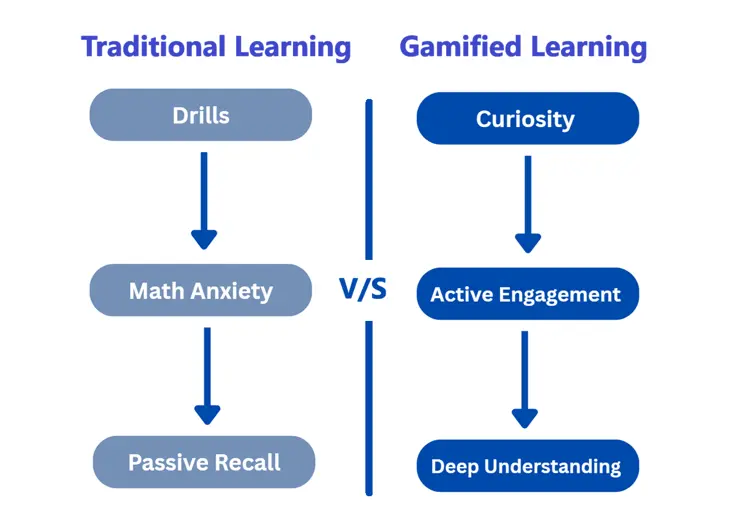
When kids are playing games that are math-related, there are a few important changes in the way they learn that occur:
- The fear of making mistakes disappears: If one answer in an examination is wrong, a red cross appears, and the student loses marks. However, when playing a game, the incorrect answer is only a hint that may help improve some strategies.
- Motivation to practice: The intrinsic motivation makes a child want to score higher, get to the next level, or find patterns. This practice becomes spontaneous rather than being assigned work.
- Playing at the right pace: Playing games allows a kid to practice at the appropriate pace and level of difficulty.
The Dopamine Factor: Why Playing Helps Remember Math Lessons
We know all kids spend many hours of the day playing games, but how and why? The answer is found in simple brain chemistry.
Whenever a child completes an objective or solves a task in a computer game, dopamine – a chemical substance associated with pleasure and concentration – is released by the brain.

When gamification techniques are implemented in mental math, the same reward mechanism gets activated:
- Immediate Success Feedback: The visual cue of stars, sound effects, or the points score system indicates that the task has been accomplished.
- Positive Reinforcement: Solving a math problem gets associated in one’s brain with an immediate positive feeling.
- Resilience and Growth Mindset: If a kid fails the level, they don’t see themselves as being bad at math; but rather see failure as valuable information for winning in the next level.
By turning math into a series of small victories, educational games remove math anxiety and ensure the formation of a positive attitude towards numbers from an early age.
Active Recall vs. Passive Learning
When a child is reading from a textbook or listening to a video tutorial, he is involved in passive learning. Information is flowing only one way and does not involve much active brainwork from the child.
On the contrary, interactive games require children to do active recall of concepts and ideas. Playing logic games such as "Guess the Number – Brain Game" involves the active work of the child in analyzing data, making quick decisions, and applying mathematical skills:
- Range Evaluation: Working out the possibilities using "higher" or "lower" feedback;
- Probability Calculations: Choosing what set of answers gives the best chance of getting the right result.
- Number Pattern Recognition: Spotting odd numbers, even numbers, prime distribution, or scale distance.
- Know the Fun Facts:Knowing the 5 fun facts of the correct number.
You can also watch the “Guess The Number – Brain Game” trailer to see how the game helps improve your child's mental math skills.
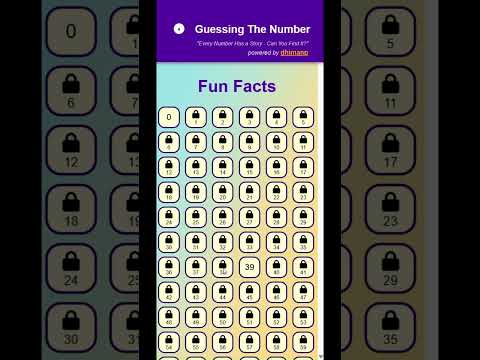
Active recall improves the connection between a child's short-term memory and long-term memory. With time, doing sums in his head becomes easy for the child, just as it is to speak a foreign language.
Instant Feedback Loop Mechanism
Under traditional classroom settings, the child attempts an assignment on Monday, submits the assignment on Tuesday, and gets feedback on the assignment only on Friday.
If the child did not get a particular concept right during problem #1, he or she will probably have committed that mistake twenty times before completing the entire worksheet. When the worksheet is handed back to the child, the wrong method has already become a part of his/her muscle memory.
The digital math games solve the problem of delayed feedback by introducing an instant feedback loop mechanism, which involves:

- In case the guess is right: The child will get instant validation and proceed towards a new concept.
- In case the guess is wrong: The mistake is highlighted instantly so that the child can adapt and fix his/her way of working immediately.
Such an iterative trial-and-error process precisely resembles the logical process followed by modern engineers, scientists, and data analysts. Through the digital math games, kids learn not just calculations but also how to hypothesize, experiment, and adjust.
Creating a True "Number Sense"
Perfect mental math skills do not come through the learning-by-heart of math tables; they emerge through the development of "number sense" – the natural perception of numbers' meaning, relations, and behavior in context.
Educational games develop number sense in three main ways:
A. Understanding Scale and Distance
Numbers can be rather abstract for children. Games make numbers tangible in the way that they appear as points on a certain scale. The perception of the real or imaginary distance between points simplifies rounding and estimation, making mental subtraction easier.
B. Recognition of Universal Patterns
In fact, all mathematics is based on patterns. Games enable kids to see patterns, symmetry, and logical structures without any formulas on a blackboard.
C. Reasoning under Stressful Conditions
Through games, kids learn how to keep their composure, concentrate, and think clearly, no matter whether it is about time pressure or a limited number of moves.
Useful Hints for Parents and Teachers to Incorporate Math Games
For getting the maximum benefit from playing educational games, it is vital to structure play properly. The following useful hints can help incorporate digital math games in the daily routine of children.
- Keep It Short: 10-15 minutes of playing math games per day would be much better than one hour of math games once a week. Short bursts would keep the mind focused without exhausting it.
- Encourage Kids to Think Out Loud: Ask your child to explain why they made a specific move when choosing one of the moves in the game or giving a guess. Explaining what they think about helps to better understand the concept and spot possible mistakes in the logic of children.
- Value Effort Over Scores: Praise kids for the effort they put into playing the game instead of the score and speed.
- Bring in Physical Objects Along with Digital Game: Combine playing digital games with the use of counting objects or even the use of a scratchpad to make the concept clear.
Preparing Minds for the Future
Even as new digital technologies emerge from 2026 onward, certain key mental skills, such as brain flexibility, logical thinking, and numeracy, will always be essential.
The world of educational games demonstrates that math can be fun and engaging. By incorporating play, immediate feedback, and the element of curiosity into the learning process, we can teach kids to enjoy learning and understand numbers.
Play educational games to help your child develop logical thinking skills, or discover all our free learning tools designed specifically for students.
Smart Tools. Easy Solutions. Right Away Online.