
How Digital Apps Are Transforming Education in 2026
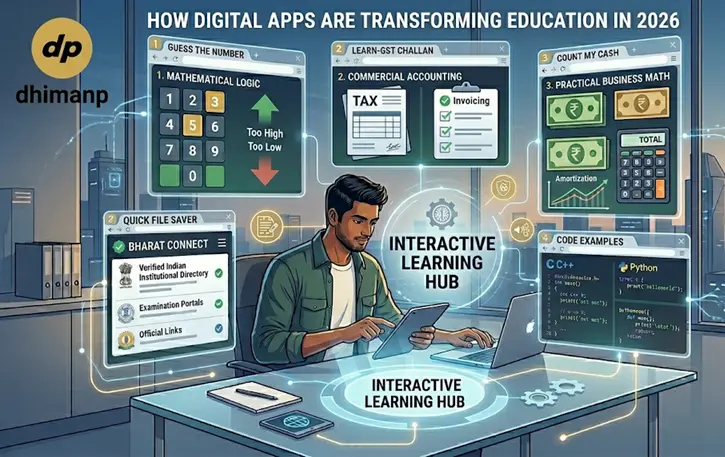
This practical instructional overview analyzes the macro-shift currently restructuring academic training models in 2026. By replacing bulky, abstract textbook methodologies with specialized, lightning-fast digital software engines, students and self-taught learners are gaining immediate hands-on technical skills. We map out exactly how eight micro-platforms across the dhimanp product ecosystem are being used in classrooms to train logical deduction, build real-world economic awareness, simplify computer programming, and establish secure data hygiene habits.
The 2026 Educational Paradigm: Transitioning from Abstract Concepts to Direct Interaction
The academic community has hit a major structural bottleneck. For generations, core concepts like commercial taxation, software architecture, mathematical logic, and data storage have been taught through static definitions and abstract lectures. Students frequently memorize theoretical rules to pass standardized tests, yet struggle to apply those concepts when entering the modern workforce.
This educational gap is amplified by bloated corporate learning management systems. Many modern learning applications require heavy storage downloads, show intrusive ads that break student focus, and force young learners through complex profile registration steps.
Traditional Theoretical Learning
The dhimanp Interactive Learning model
To break through this informational barrier, academic institutions in 2026 are turning to clean, single-purpose web utilities and mobile application toolkits. Grounded in the dhimanp brand architecture, these micro-tools provide instant interactive sandboxes directly inside any standard browser window. Free from login walls and data-harvesting trackers, these applications let students test concepts in real time.
This strategic handbook breaks down how eight vital utilities are reshaping modern instruction, categorized across four foundational pillars of learning.
Pillar 1: Gamifying Mathematical Logic and Algorithmic Thinking
Developing computational thinking skills requires more than rewriting algebraic formulas on a chalkboard. True problem-solving is rooted in iterative estimation, logical deduction, and analyzing rapid feedback loops. Deploying lightweight, gamified digital logic engines is an excellent way to keep students naturally engaged.
The Gamified Logic Workflow:
- Application Focus: The dhimanp Guess The Number Game.
- The Classroom Method: Instead of presenting dry binary search algorithms on a slider board, instructors have students find hidden numeric keys within a dynamic canvas. The algorithm evaluates student input instantly, responding with clear Too High or Too Low indicators.
- The Learning Outcome: Students naturally discover optimized search intervals and binary partitioning patterns. By interacting with immediate feedback loops, young learners develop structural data intuition without getting bogged down by dense engineering jargon.
Pillar 2: Cultivating Functional Financial Literacy and Business Math
A major critique of traditional education has long been its lack of practical financial preparation for adulthood. Concepts like multi-tier sales taxes, bank note auditing, and compounding debt schedules are often ignored because they are difficult to simulate without expensive accounting suites. Combining targeted mobile frameworks with local browser scripts bridges this gap beautifully.
The Applied Financial Operations:
A. Interactive Fiscal Simulation via Learn-GST Challan
- Application Focus: The dhimanp Learn-GST Challan Simulator.
- The Classroom Method: Business students step away from abstract textbooks and log onto an interactive, zero-risk simulation panel. They practice entering corporate taxpayer identification profiles, calculating direct net values, and generating realistic tax challenge files.
- The Learning Outcome: This hands-on process demystifies commercial public accounting rules, helping students confidently master statutory compliance steps.
B. Handheld Monetary Auditing via Count My Cash App
- Application Focus: Count My Cash: EMI GST Calc on the Google Play Store.
- The Classroom Method: Economics students run simulated retail closeout events right from their smartphones. They use the cash counter interface to tally local physical currency note bundles, split transactions through the built-in GST portal, and test compounding amortization graphs in the loan planner.
- The Learning Outcome: This 3-in-1 application brings precision tracking to business arithmetic classes, training students to analyze financial equations on a single, ad-free screen.
Pillar 3: Lowering Barriers in Engineering and Coding Education
Computer programming has become a core literacy skill alongside reading and writing. However, setting up complex code execution environments often frustrates beginners with cryptic terminal warnings and configuration bugs. Providing access to clean, isolated development utilities removes this unnecessary friction.
The Software Engineering Workflows:
A. Blueprint Analysis via Code Examples Catalog
- Application Focus: The dhimanp Code Examples Library.
- The Classroom Method: Students learning modern web engineering browse an organized directory of clean, functional code blocks. Rather than wading through overwhelming documentation, they study standalone, production-ready syntax snippets.
- The Learning Outcome: Reviewing clean code blueprints teaches beginners how to properly structure applications. It demonstrates the direct link between abstract syntax lines and crisp, visual components.
B. Interface Analysis via Keyboard Tester Canvas
- Application Focus: The dhimanp Keyboard Tester.
- The Classroom Method: Hardware engineering students open the diagnostic canvas to study peripheral data pipelines. They observe the exact millisecond key code signals and hardware pulses flash across the visual screen matrix.
- The Learning Outcome: This real-time analysis reveals how computing hardware handles user input. It provides a simple, direct way to study key-ghosting limits, signal latency, and peripheral circuit paths.
Pillar 4: Streamlining Digital Safety and Classroom Organization
True digital literacy involves teaching students how to protect their personal data, evaluate online sources, and move project files securely between devices. Integrating single-purpose file utilities into daily routines naturally builds these critical data-hygiene habits.
The Student Productivity and Safety Frameworks:
A. Safe Research Navigation via Bharat Connect Directory
- Application Focus: The Bharat Connect Link Index.
- The Classroom Method: When researching official civic programs or public data sets, students bypass generic, ad-heavy search engines. Instead, they navigate through a clean, spam-free national resource index.
- The Learning Outcome: Students learn to recognize authenticated public domains while keeping their browser records safe from malicious tracking cookies and confusing ad redirects.
B. Sanitized Data Portability via Quick File Saver and dhimanp QR Code Generator
- Application Focus: The Quick File Saver Workspace and dhimanp QR Code Generator.
- The Classroom Method: Students drop temporary research snippets and project URLs into the registration-free text panel. They sanitize their notes and export them cleanly into specialized file formats (such as .docx, .pdf, .c, or .cpp). From there, they run the destination links through the generator script to create crisp QR vectors for project posters.
- The Learning Outcome: This workflow teaches the fundamentals of file organization and local storage. Students learn how to share academic data safely without relying on intrusive cloud-sharing services that require tracking profiles.
Summary of the 2026 Interactive Application Educational Framework
To see how these applications fit into a modern learning ecosystem, explore our core utility matrix:
| Tool Application | Academic Focus Area | Key Student Activity | Core Learning Outcome |
|---|---|---|---|
| Guess The Number | Mathematical Logic | Iterative Number Guessing | Masters binary search concepts and estimation. |
| Learn-GST Challan | Commercial Accounting | Corporate Tax Simulation | Demystifies statutory business tax compliance. |
| Count My Cash | Practical Business Math | Handheld Fiscal Auditing | Runs currency logs and exports EMIs to Excel. |
| Code Examples | Web Engineering | Blueprint Syntax Analysis | Teaches modular application architecture. |
| Keyboard Tester | Hardware Electronics | Peripheral Signal Testing | Analyzes input latency and hardware ghosting. |
| Bharat Connect | Civic Research | Secure Portal Navigation | Teaches verification of digital resource routes. |
| Quick File Saver | Data Processing | Clean Document Exporting | Sanitizes research logs into local file systems. |
| dhimanp QR Code | Information Media | Graphic Vector Generation | Deploys scannable print links for presentations. |
Conclusion: Empowering the Next Generation with Targeted Utility Toolkits
The ongoing transformation of education in 2026 highlights a vital truth: true learning flourishes when students can actively interact with concepts. Moving away from rigid, text-heavy curricula toward responsive digital sandboxes gives learners the freedom to explore, experiment, and succeed on their own terms. By choosing clean, single-purpose applications to analyze hardware, write code, run financial calculations, and secure data pipelines, classrooms become vibrant spaces of practical discovery.
Equip your learning environment with the right tools today. Explore the open dhimanp product ecosystem and download Count My Cash: EMI GST Calc on the Google Play Store to experience an efficient, interactive approach to modern education.